| AIM Statement | Strategic Alignment | Baseline Data | Measure | Project Charts | |
|---|---|---|---|---|---|
| EHI CUSTOMER SATISFACTION SURVEY | By December 31, 2025 increase response to EHI customer service surveys from 2% to 10%. |
1. Focus on Core Public Health Advocate for policies that promote population health. 3. Advance a Culture of Quality Maintain and ensure a workforce development plan to support public health competency. Maintain or surpass national public health accreditation standards. |
Past surveys have had a low response rate of 2%. | 10% of entities receiving environmental health (EHI) services will have completed customer service responses. |

|
| AIM Statement | Strategic Alignment | Baseline Data | Measure | Project Charts | |
|---|---|---|---|---|---|
|
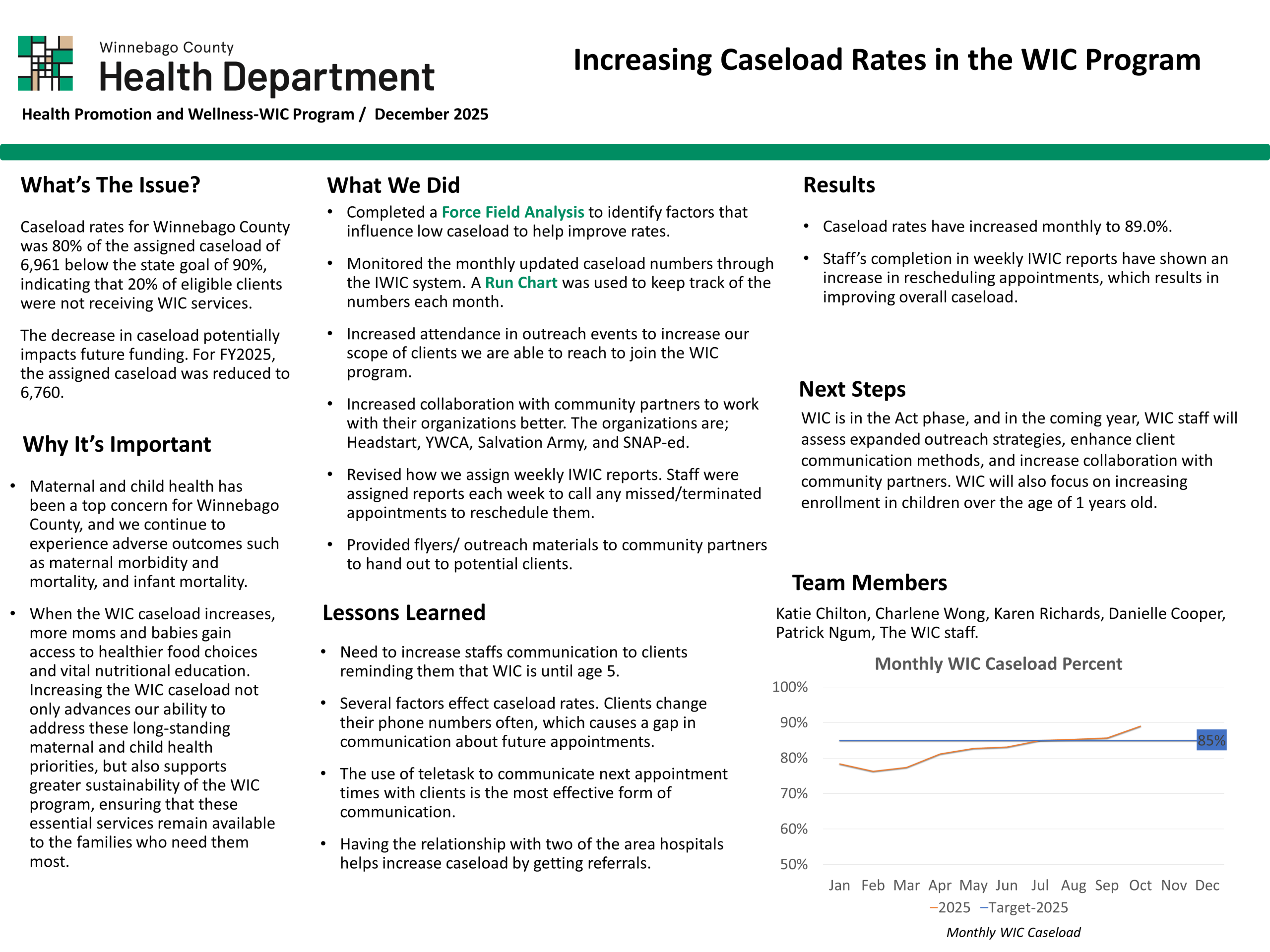
INCREASING CASELOAD RATES IN THE WIC PROGRAM |
By Dec 31st 2025, WIC caseload rates will increase to 85% of the assigned caseload of 6,760 or 5746 clients. |
1. Focus on Core Public Health Assure development and implementation of plans to address health priorities – Maternal and Child Health. |
In FY2024, the caseload rate for Winnebago County’s WIC program was 80% of the assigned caseload. | WIC case load rates will increase to 85%. |
|
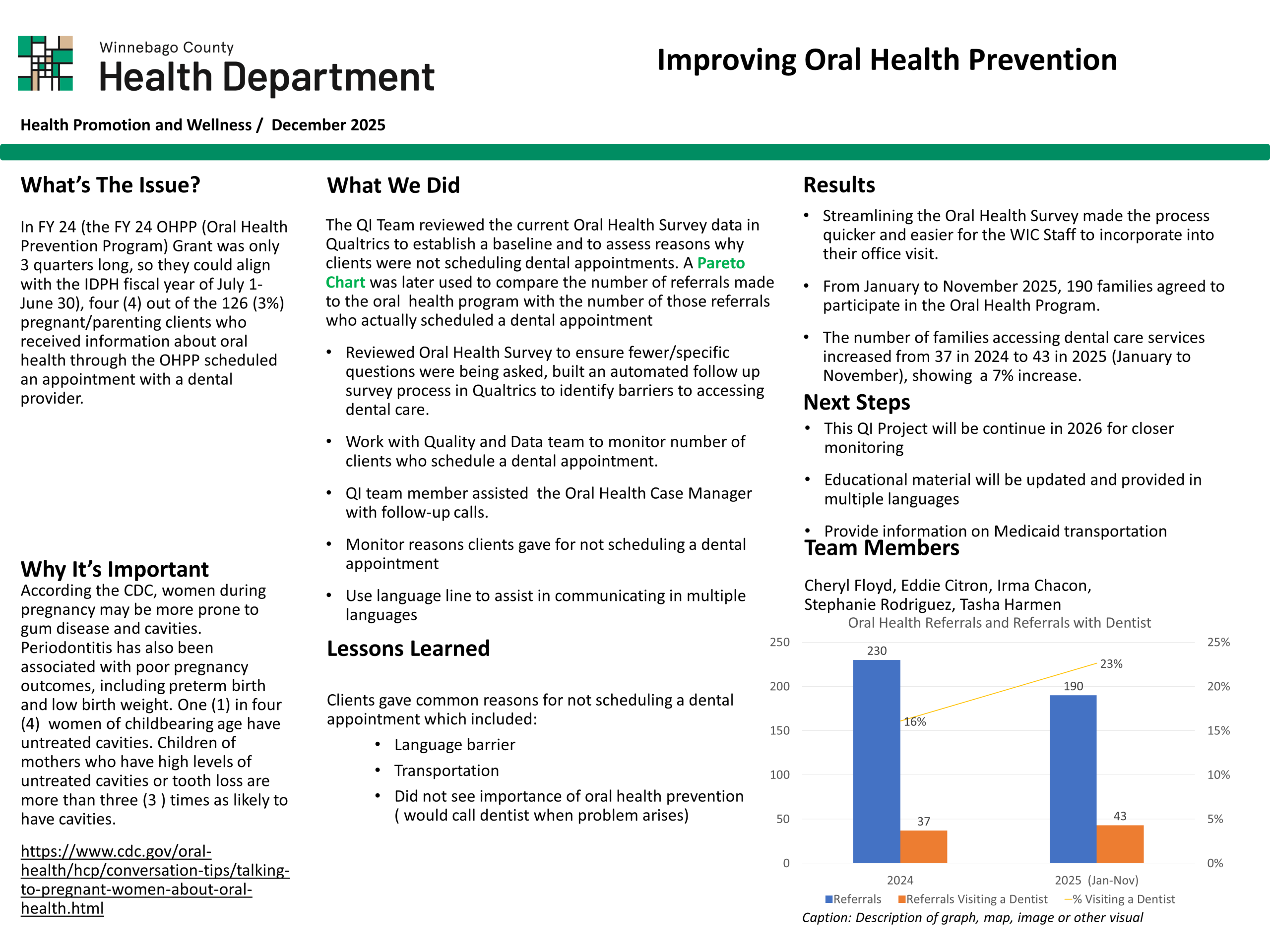
| IIMPROVING ORAL HEALTH PREVENTION | By December 31st 2025, The OHPP (Oral Health Prevention Program) will increase the number of referred pregnant and parenting families who schedule a dentist appointment from 3% to 10%. |
1. Focus on Core Public Health Assure development and implementation of plans to address health priorities – Maternal and Child Health. |
Approximately 3% of pregnant/parenting clients who received information about oral health through the OHPP scheduled an appointment with a dental provider. | 10% of pregnant/parenting clients who receive information about oral health through the OHPP will schedule an appointment with a dental provider. |
|
| AIM Statement | Strategic Alignment | Baseline Data | Measure | Project Charts | |
|---|---|---|---|---|---|
|
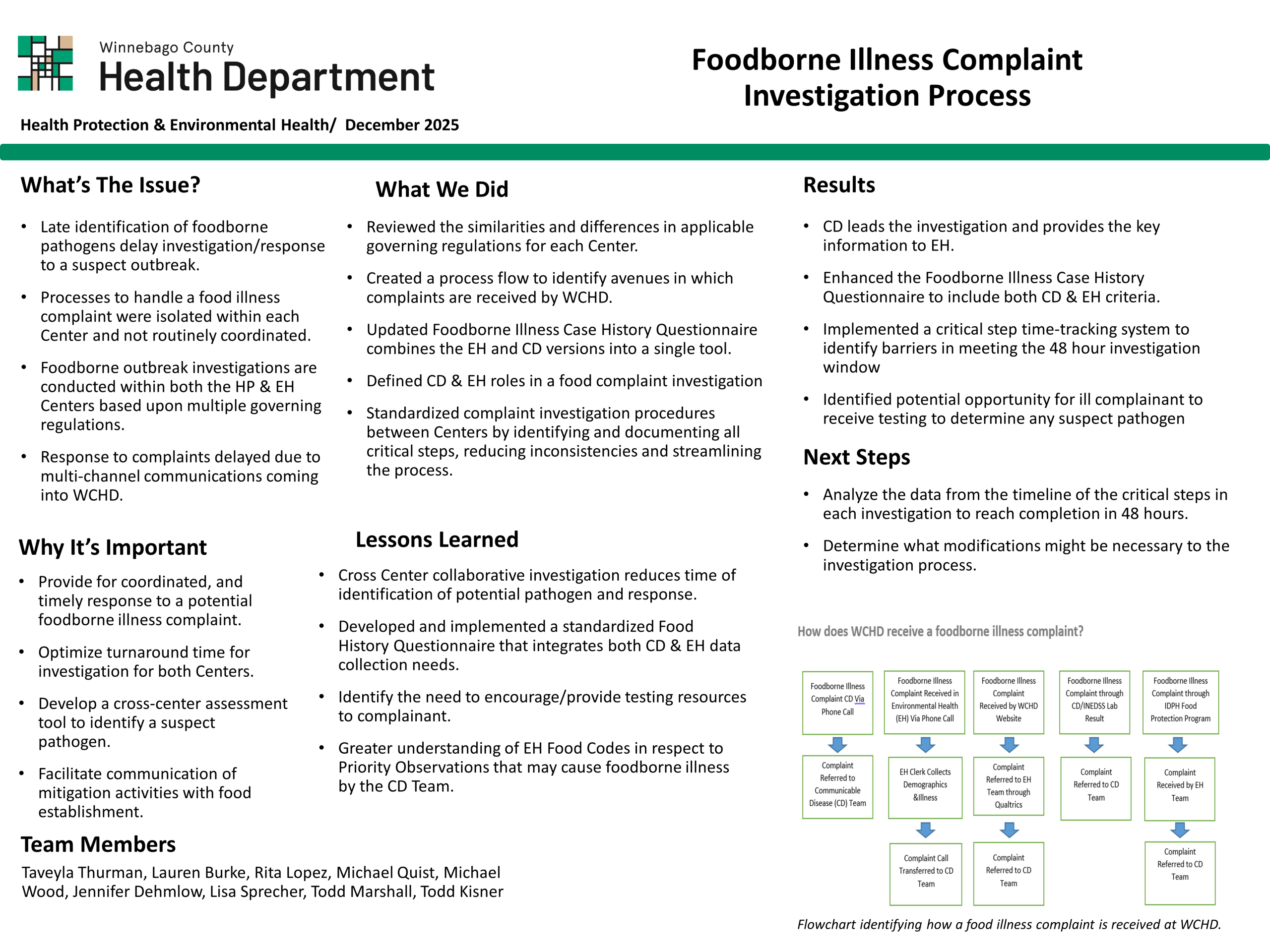
FOODBORNE ILLNESS COMPLAINT INVESTIGATION PROCESS |
By December 31, 2025, WCHD will respond to an identified foodborne illness or suspected outbreak within 48 hours of notice with an assessment/mitigation plan and a reopen strategy for the food establishment (if closed) to return to normal operations. |
1. Focus on Core Public Health Advocate for policies that promote population health 2. Develop and Enhance Systems to Support Core Public Health Organize internally to support strategic initiatives. |
Approximately seven (7) working days to complete a foodborne illness investigation. | Response time to identified food borne illness would be reduced to 48 hours. |
|
| AIM Statement | Strategic Alignment | Baseline Data | Measure | Project Charts | |
|---|---|---|---|---|---|
|
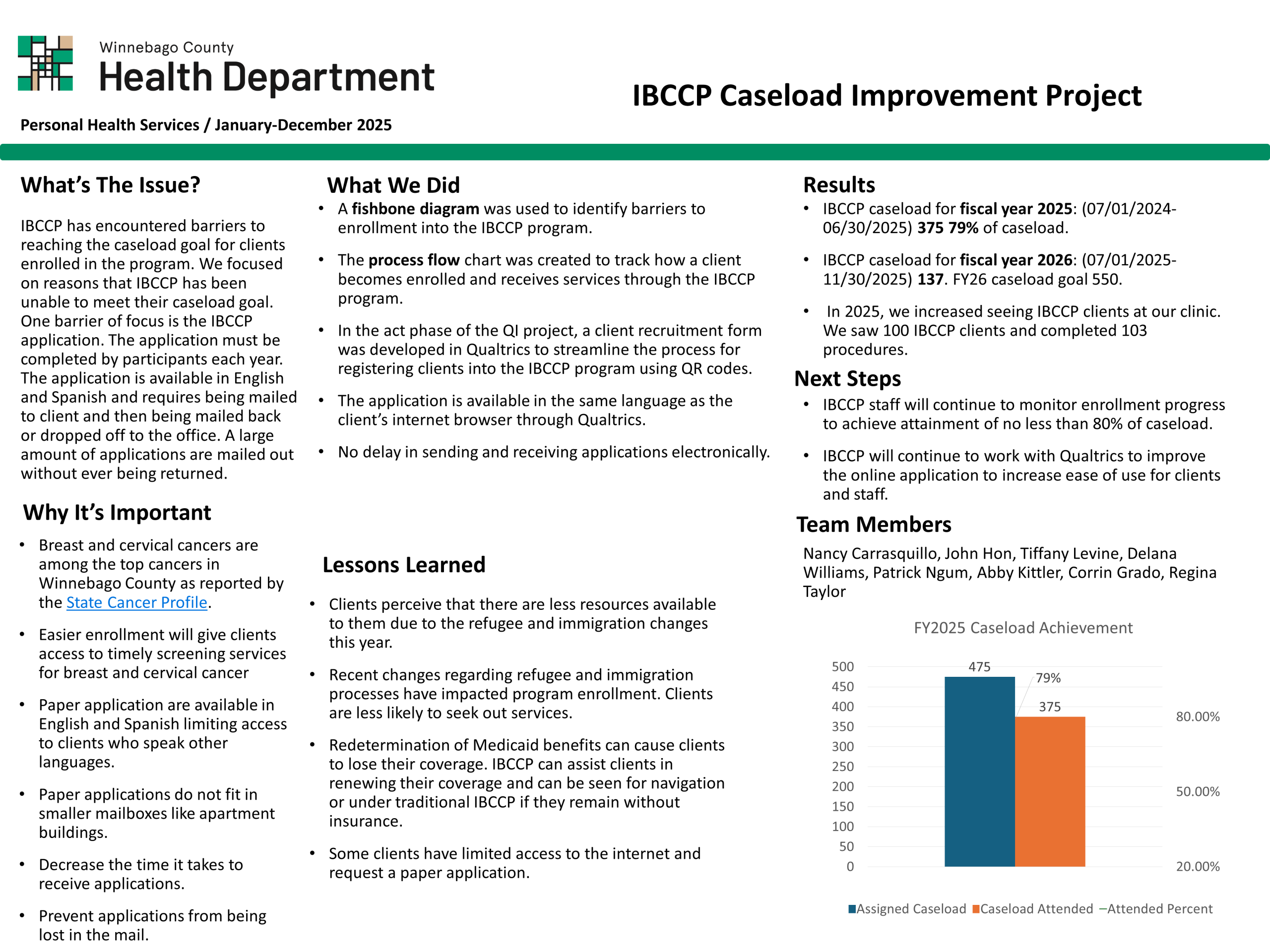
IBCCP CASELOAD IMPROVEMENT PROJECT |
IBCCP will attain 80% of caseload goal by serving 380 participants by June 30, 2025. IBCCP will have a stretch goal of 475 participants enrolled and receiving services by December 31st, 2025. |
1. Focus on Core Public Health Assure development and implementation of plans to address health priorities – Maternal and Child Health. 2. Develop and Enhance Systems to Support Core Public Health Organize internally to support strategic initiatives. Engage with community partners to address health priorities. 3. Advance a Culture of Quality Inform community on public health initiatives and impact. |
Illinois Breast and Cervical Cancer Prevention (IBCCP) program had a caseload of 442 participants for FY 2024, this was 80% of the assigned caseload goal of 550. | Increase in IBCCP caseload to 380 participants reaching 80% of caseload goal by June, 2025. With a stretch goal of 475 by December 31st 2025. |
|
| AIM Statement | Strategic Alignment | Baseline Data | Measure | Project Charts | |
|---|---|---|---|---|---|
|
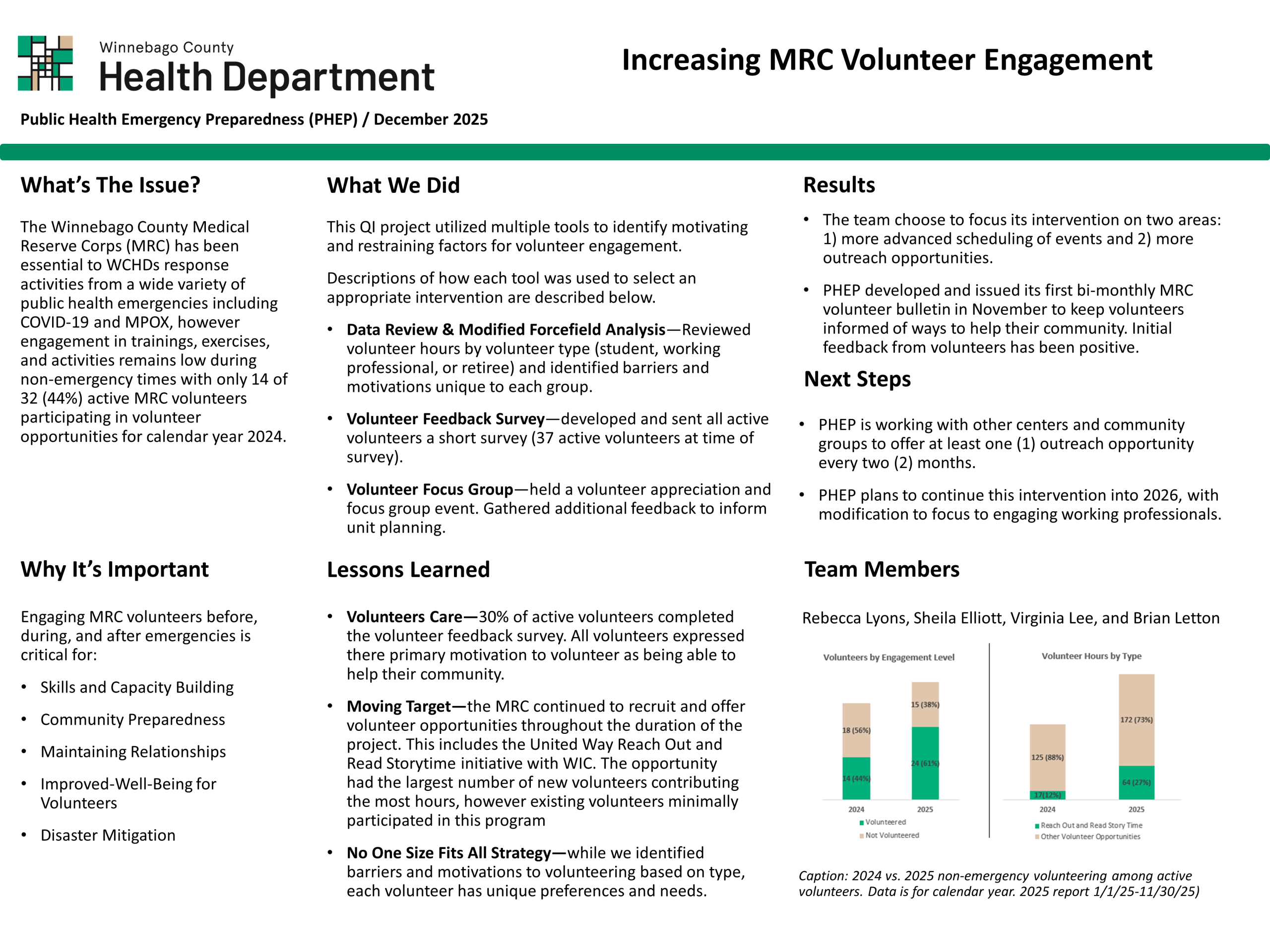
INCREASING MRC VOLUNTEER ENGAGEMENT |
By December 31. 2025, increase the percentage of Winnebago County MRC Volunteers participating in one or more volunteer opportunities annually from 44% (14 to a minimum of 66% (21). |
2. Develop and Enhance Systems to Support Core Public Health Organize internally to support strategic initiatives. Engage with community partners to address health priorities. |
44% of MRC Volunteers (14 out of 32 volunteers) participate in one or more volunteer opportunities annually. | 66% of MRC Volunteers will participate in one or more volunteer opportunities annually. |
|
| AIM Statement | Strategic Alignment | Baseline Data | Measure | Project Charts | |
|---|---|---|---|---|---|
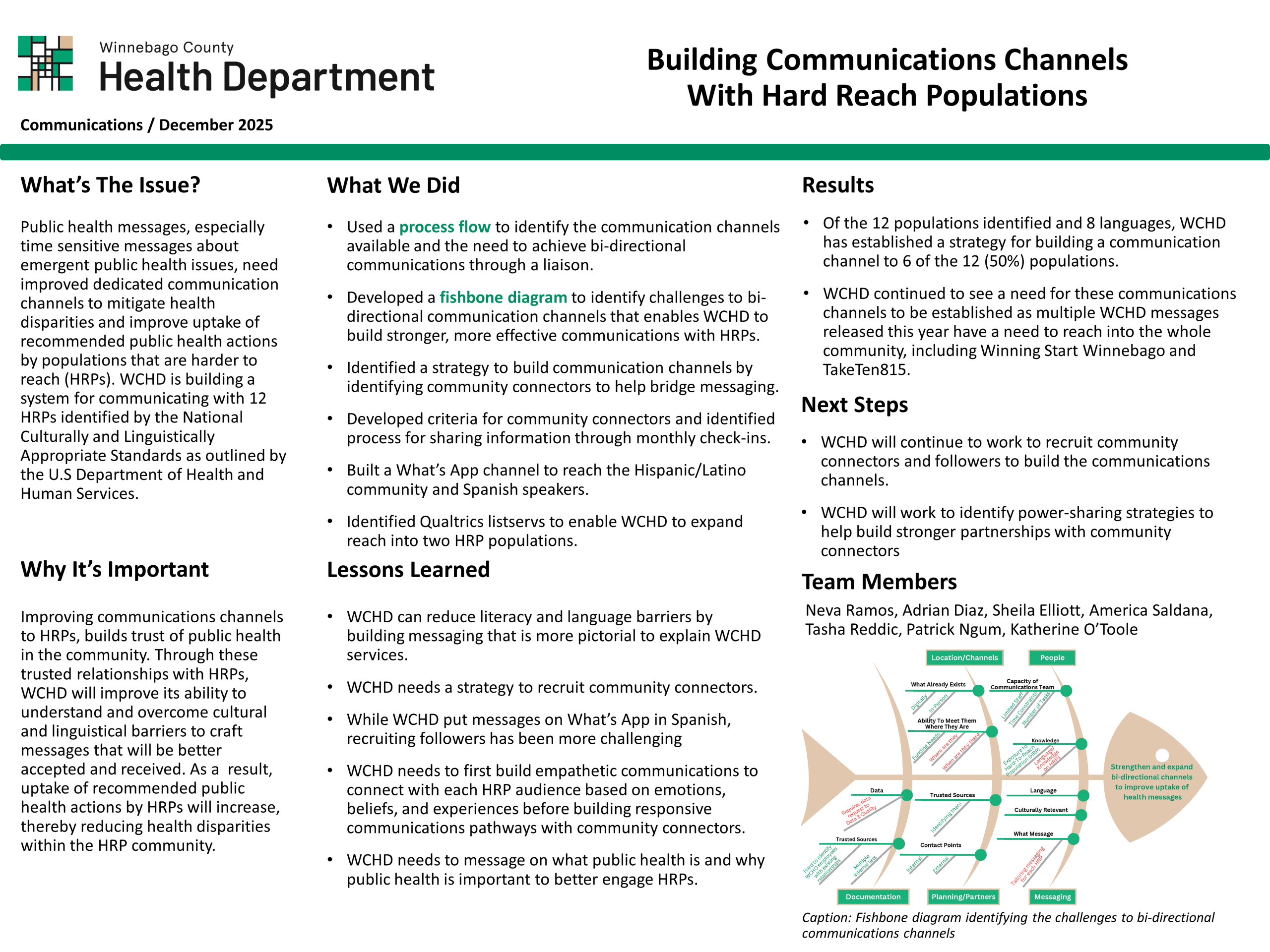
| COMMUNICATIONS: BUILDING COMMUNICATIONS CHANNELS WITH HARD REACH POPULATIONS | Identify communication channels WCHD can utilize to connect with the 12 identified hard to reach populations, develop a procedure for building bi-directional communications, and establish the communication channel by providing culturally relevant public health messaging to address a health priority and or disparity for 25% (3/12) of the identified groups by December 31, 2025. |
2. Develop and Enhance Systems to Support Core Public Health Engage community partners to address health priorities. 3. Advance a Culture of Quality Inform community on public health initiatives and impact. |
There are emergency communications channels identified, but WCHD needs to develop dedicated communications channels to hard to reach populations to build trust and bi-directional communications based on health needs to address health priorities. | A WCHD Communication channel is identified and built for reaching 3 (25%) of the 12 identified populations and WCHD has developed culturally relevant public health messages to address a health disparity or priority for each by the end of 2025. |
|
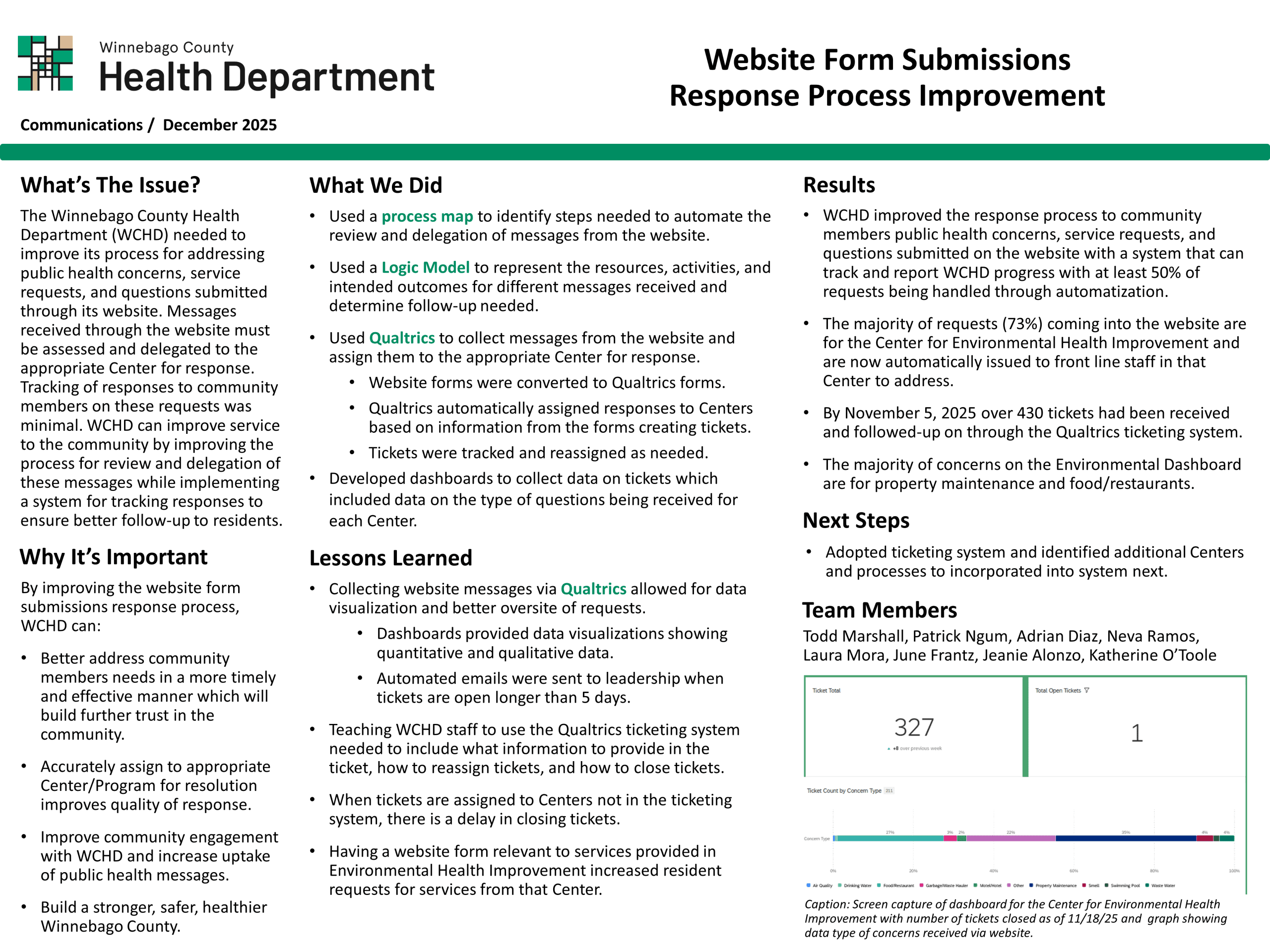
| COMMUNICATIONS: WEBSITE FORM SUBMISSIONS RESPONSE PROCESS IMPROVEMENT | Identify and initiate a process for automating the review and delegation of public health concerns, service requests, and questions from website to address 50% of the messages by December 31, 2025 and implement a tracking system for follow-up communications with a minimum of 50 follow-ups tracked by December 31, 2025. |
2. Develop and Enhance Systems to Support Core Public Health Organize internally to support strategic initatives. 3. Advance a Culture of Quality Inform community on public health initiatives and impact |
Currently, online public health concerns, service requests, and questions from website all come in to the contactus@publichealth.wincoil.gov email and 0% of the follow-up process is automated nor tracked through a system. | Improved efficiency of response to community members public health concerns, service requests, and questions with a system that can track and report WCHD progress with at least 50% of requests being handled through the automatization and tracking system. |
|
|
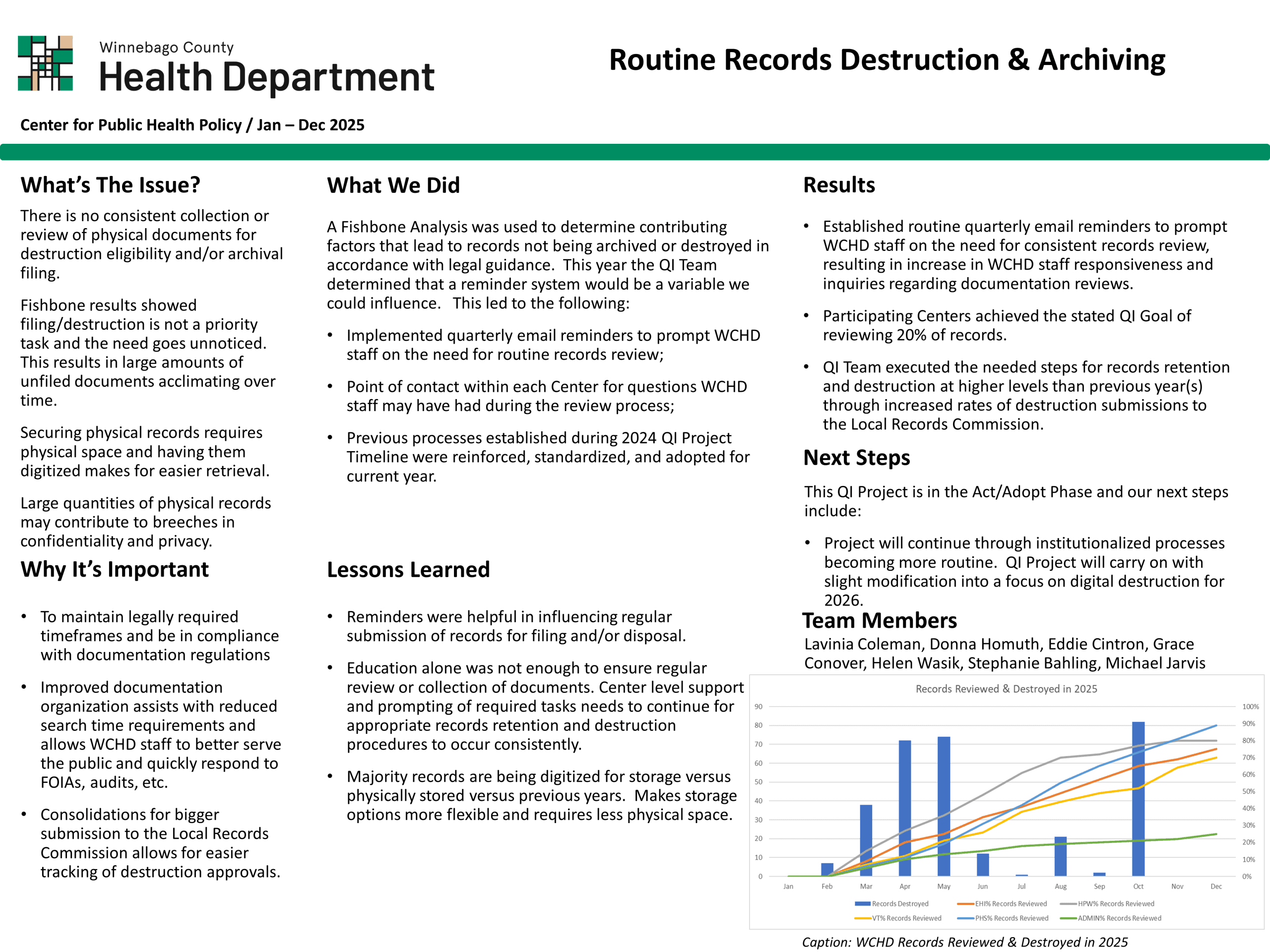
PUBLIC HEALTH POLICY: ROUTINE RECORDS DESTRUCTION & ARCHIVING |
By December 31, 2025, increase documentation reviews for destruction and/or archiving by 20%. |
2. Develop and Enhance Systems to Support Core Public Health Organize internally to support strategic initiatives. 3. Advance a Culture of Quality Maintain and ensure a workforce development plan to support public health competency. Maintain or surpass public health accreditation standards. |
Participating Centers reported the following baseline rate of documentation reviews from 2024– EHI: 62% Vital Recs: 40% HPW: 25% |
A 20% increase in WCHD Centers successfully searching for and collecting eligible physical documents for destruction or archiving. |
|
|
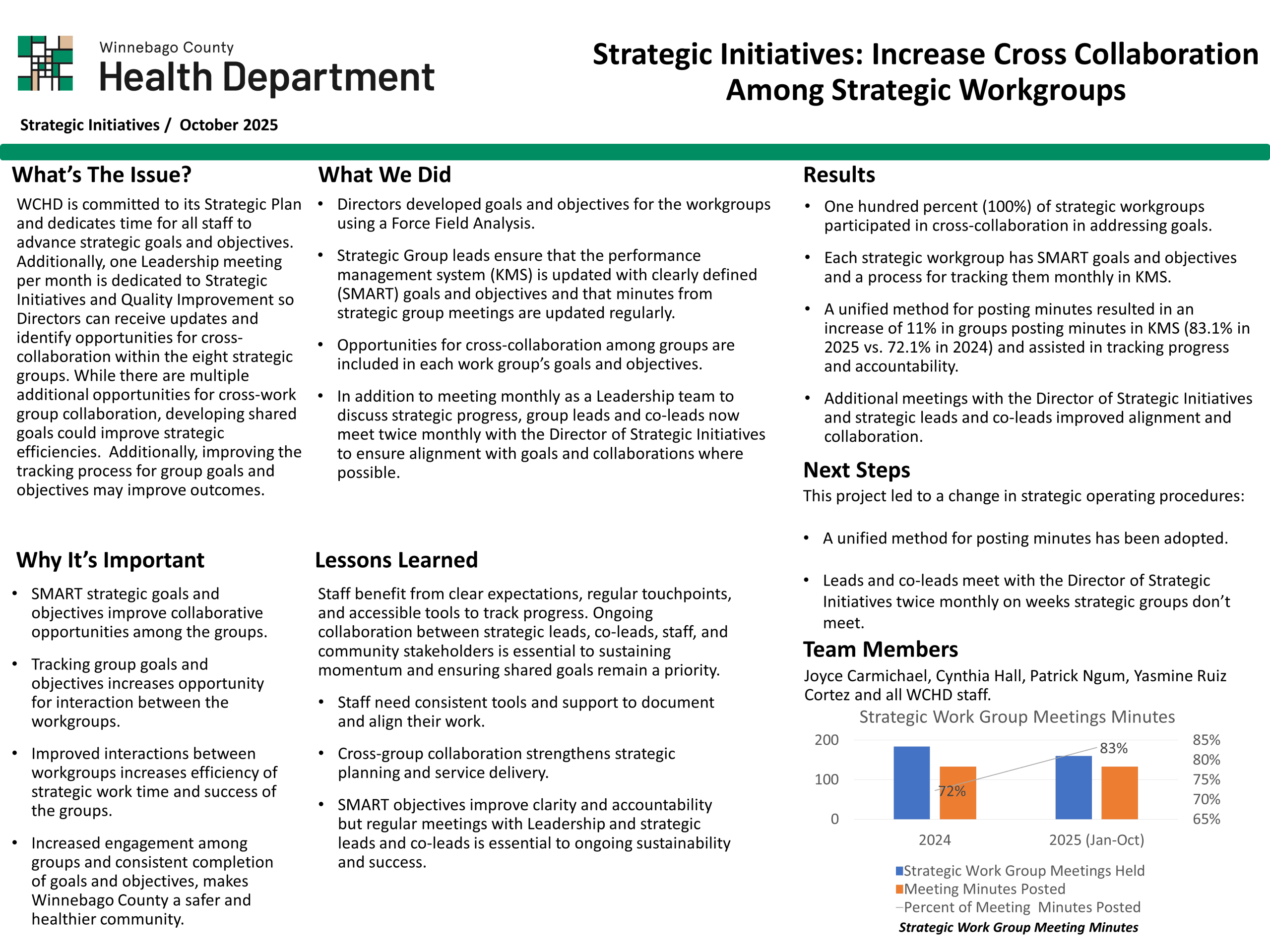
STRATEGIC INITIATIVES: INCREASE CROSS COLLABORATION AMONG STRATEGIC WORKGROUPS |
By January 31, 2025, all Directors will collaborate and develop goals and objectives for each Strategic Workgroup. By March 30, 2025, each Strategic Workgroup will have developed a minimum of three (3) SMART goals and objectives with at least one goal including cross-collaboration with other strategic workgroup. All goals and objectives will be documented in WCHD’s Performance Management System (PMS), KMS. By December 31, 2025, each Strategic Workgroup can demonstrate collaborating to achieve goals and objectives through monthly postings of their minutes in KMS which will be tracked by the Director of Strategic Initiatives. |
1. Focus on Core Public Health Assure development of plans to address health priorities. 2. Develop and Enhance Systems to Support Core Public Health Organize internally to support strategic initiatives. 3. Advance a Culture of Quality Maintain and ensure a workforce development plan to support public health competency. Maintain or surpass national public health accreditation standards. |
Currently, Leadership dedicates approximately 45 minutes per month to discuss Strategic Initiatives as a group. The majority of that time involves each Director reporting on the progress of their strategic workgroup. |
All Center Directors will develop goals and objectives by January 31, 2025, documented in KMS. Each strategic workgroup would establish at least 3 SMART goals (1 cross-collaborative) by March 30, 2025. Goals and objectives would be entered into KMS by March 30, 2025, with ongoing updates. By December 31, 2025, each Strategic Workgroup would demonstrate collaborating to achieve goals and objectives through Monthly meeting minutes posted in KMS. |
|
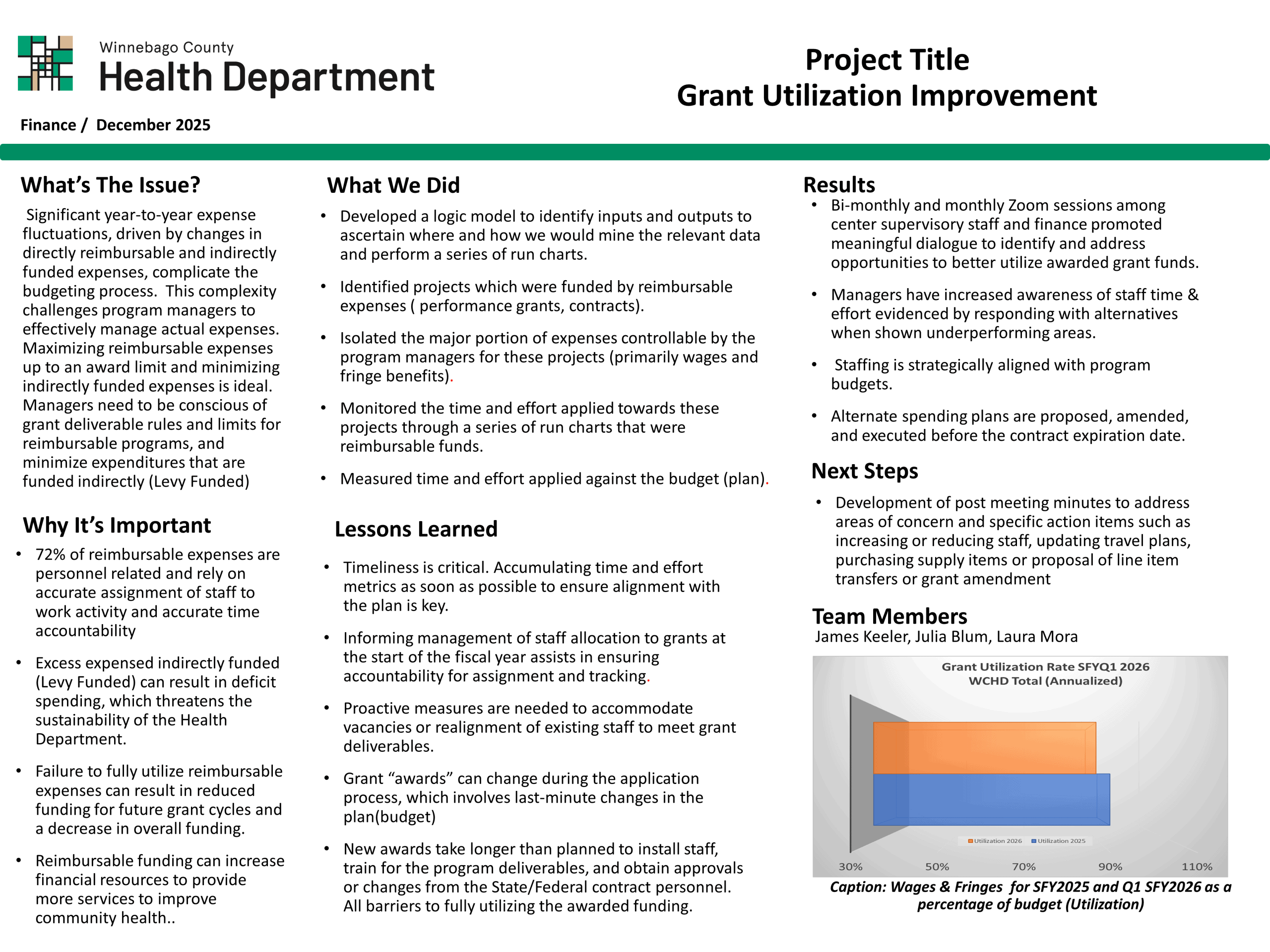
| FINANCE: GRANT UTILIZATION IMPROVEMENT | By December 31, 2025, develop and implement an expense classification training program that effectively equips program managers to identify and accurately classify reimbursable and non-reimbursable expenses and increase grant fund utilization from 90.4% in FY2024 to at least 92.5% of the total contract or award amount in FY2025. |
2. Develop and Enhance Systems to Support Core Public Health Organize internally to support strategic initiatives. 3. Advance a Culture of Quality Maintain and ensure a workforce development plan to support public health competency. Maintain or surpass public health accreditation standards. |
In the past two(02) years grant fund utilization rates for WCHD were: FY2023: 88.2% and FY2024: 90.4%. |
Utilization of grant funding rate increases from 90.4% (FY2024) to at least 92.5% (FY2025). At least 90.0% of trained managers accurately classify expenses as reimbursable and non-reimbursable. |
|
|
DATA AND QUALITY: DATA REQUEST PROCESS AND RESPONSE TIME |
By December 31st, 2025, reduce the number of business days to respond to data requests by 30% dependent on system. |
1. Focus on Core Public Health Assess health status of the population 2. Develop and Enhance Systems to Support Core Public Health Organize internally to support strategic initiatives. Engage with community partners to address health priorities. 3. Advance a Culture of Quality Maintain and ensure a workforce development plan to support public health competency. Inform community on public health initiatives and impact. |
Challenges with data retrieval, definition, and access exist within the multiple WCHD data systems and have not been documented or addressed (the estimated time to complete a data request ranges from 3 days to 30 days. | Reduction in the number of business days to respond to data requests by 30%. |

|